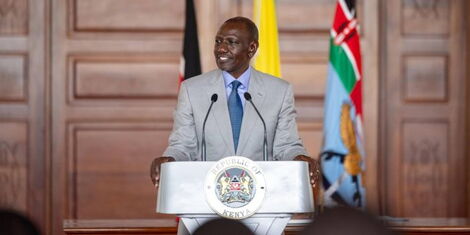
President William Ruto has hinted at a complete overhaul of the Higher Education Loans Board (HELB) in a move aimed at establishing a more predictable and student-centred funding system.
Speaking in Naivasha during the National Education Conference on Thursday, May 7, the Head of State said the move will ensure an equitable share of government funding to students in universities and colleges.
According to Ruto, the current financing framework has faced serious challenges, admitting that it had prioritised institutions rather than the students’ direct needs.
The President has directed HELB Chief Executive Officer Geofrey Monari, alongside other Ministry of Education officials, to spearhead the restructuring of the funding body and to design a system that guarantees predictable funding for the students.
University students accessing HELB services.
University students accessing HELB services. Photo SMG
“We want to sort out HELB so that we can have clarity, and I have instructed Monari, together with my team giving them some assignment that we must finally end up with predictable resources,” Ruto stated.
Meanwhile, Ruto maintained that the government has corrected the funding approach to ensure that it is aligned to the specific requirements of the learner rather than the complex administrative structures within institutions of higher learning.
“We had very serious challenges with the funding model that was more focused on the institution than the learner, and we have corrected that,” he added.
At the same time, the President announced plans to digitise the entire student funding system in what he argues will improve transparency and make decision-making faster and more efficient.
The digitisation drive is also expected to reduce delays and inefficiencies that have long affected the disbursement of student loans and support.
“We will also digitise the whole system so that we improve on transparency, making it easy for decision making,” he said.
According to President Ruto, the objective of the overhaul is to eliminate uncertainty in student financing and ensure that resources are readily available when needed, a long-standing concern among university students and parents.
The move comes as the Treasury proposes Ksh87.6 billion for scholarships and student loans in the 2026/27 financial year.
It is also worth noting that the government has already restructured the HELB model, introducing a mixed funding system that combines scholarships, loans, and household contributions, with the most vulnerable students receiving a higher share of scholarships and loan support.